In the manufacturing and maintenance of power transformers, winding insulation is a key factor affecting equipment lifespan and operational reliability. Among numerous insulation materials, diamond dotted paper (DDP) has become a commonly used material for interlayer insulation of high-voltage and distribution transformer windings due to its unique structural design and excellent mechanical and electrical properties.
This article will comprehensively introduce the structure, performance, applications, and selection of DDP, helping you make more appropriate decisions in engineering design and global procurement.
DDP is made by coating high-purity insulating kraft paper as a base material with thermosetting epoxy resin dots (arranged in a diamond pattern) on its surface in a regular pattern.
Base Material: Electrical grade insulating paper with high mechanical strength and high dielectric properties.
Adhesive Dots: Stage B epoxy resin, in a semi-cured state.
Arrangement: Regular diamond dot matrix, ensuring uniform adhesion.
During the heating and drying or operation of the winding, the resin dots soften and solidify under heat, which firmly bonds the winding layers and forms an integral structure.
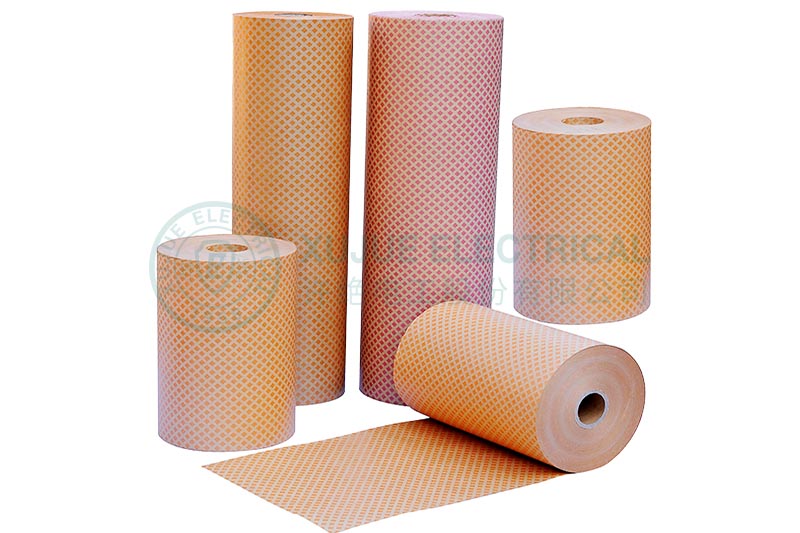
DDP achieves tight bonding between winding turns and layers through heat curing, preventing loosening during operation.
Under short-circuit impact, the windings will not deform due to electrodynamic forces, enhancing short-circuit withstand capability.
Provides stable dielectric strength
Reduces the risk of partial discharge
The diamond-shaped dot structure ensures a certain oil gap, facilitating cooling oil flow and improving heat dissipation performance.
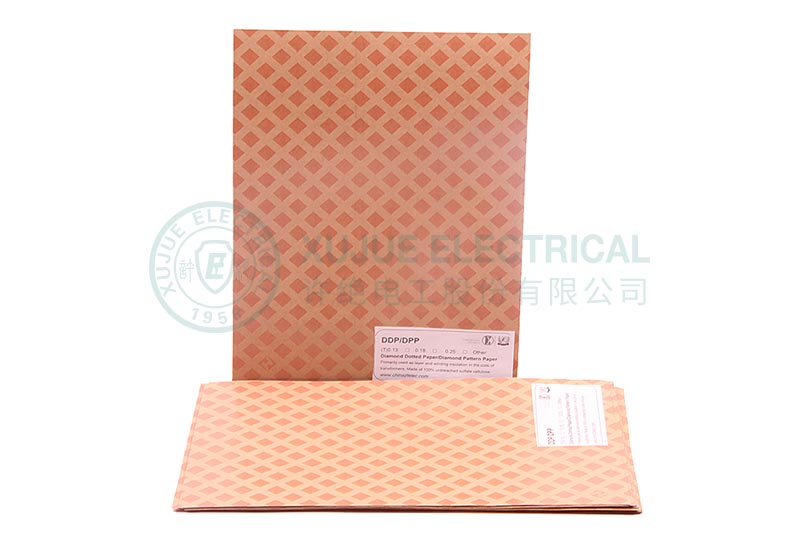
When selecting, the following parameters should be given special attention:
High tensile strength
Good folding resistance
Not easily damaged during processing
High breakdown voltage
Low dielectric loss
Strong insulation stability
Common temperature resistance level: 105℃
Special modified products can reach 120℃ or higher
Uniform adhesive dots
Firm bonding after curing, no delamination or dripping
To fully utilize the performance of diamond dotted paper, the correct process flow must be followed:
On the winding machine, the diamond dotted paper is laid between layers (between conductor layers) or as end insulation. At this stage, the material is uncured. The operator must ensure that the adhesive dots face the opposite conductor to be bonded (usually towards the adjacent layer on the inside or outside of the winding).
After the wound winding is installed into the transformer, it undergoes vacuum drying. This is a crucial step in activating the diamond dotted paper.
Temperature Control: The activation temperature of the epoxy resin must be reached (usually above 110℃).
Pressure Control: During the drying process, axial pressure is applied to the winding to ensure that the adhesive dots melt and make tight contact for curing.
After curing, the winding forms a dense whole, significantly improving its resistance to short-circuit impacts.
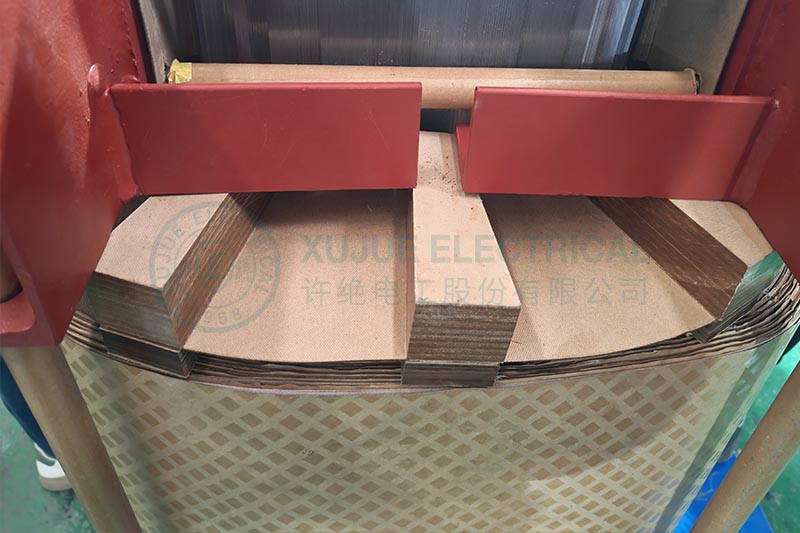
Common thicknesses are 0.08 mm, 0.13 mm, 0.18 mm, and 0.25 mm. Thinner DDP is used for small transformers, while thicker DDP is used for large-capacity transformers.
Pay attention to dot diameter, dot spacing, and adhesive application rate (g/m²). Ensure uniform DDP dot distribution to avoid poor adhesion or excessive bonding in certain areas.
Select according to the transformer’s design temperature rise:
Standard power distribution: 105℃.
High-temperature environment: 120℃ or modified products.
The diamond dotted paper must be compatible with transformer oil, pressboard, coil conductor enamel, and other materials.
Diamond dotted insulating paper has become a key material for oil-immersed transformer windings due to its excellent adhesion, reliable electrical insulation capabilities, and high cost-effectiveness. If you are looking for a highly stable transformer insulation solution, paying attention to the dot density, substrate purity, and thermosetting parameters of the diamond dotted paper is crucial to ensuring product quality.
Q1: How to determine whether the adhesive dot quality of diamond dotted paper meets the standard?
Qualified adhesive dots should be uniformly distributed without extensive adhesion or missing areas. After thermosetting testing (simulating transformer drying process), the adhesive dots should completely melt, level, and form a continuous adhesive surface, without powdering or brittleness.
Q2: What are the storage requirements for diamond dotted paper?
This material is thermosetting and should be kept away from high temperatures before use. It is recommended to store it in a dry, well-ventilated environment below 25℃, avoiding direct sunlight, which can prevent pre-curing failure of the adhesive dots. The shelf life is usually 12 months.
Q3: Does DDP require preheating?
Generally, curing is completed during winding drying or hot pressing, and no special preheating is required.
Q4: Can diamond dotted paper replace Nomex?
It is not recommended to replace it in high-temperature scenarios, but it is perfectly suitable for conventional oil-cooled transformers.
If you need our products please write down any questions, we will reply as soon as possible.
There are three ISO certificates for quality certification. The certificates will be shown later. ISO
After receiving the advance payment, the production cycle is 15-25 days. And the transportation cycle should be calcul……
We supply with installation guide and user manual for each transformer. If you do not understand them. We will offer v……
