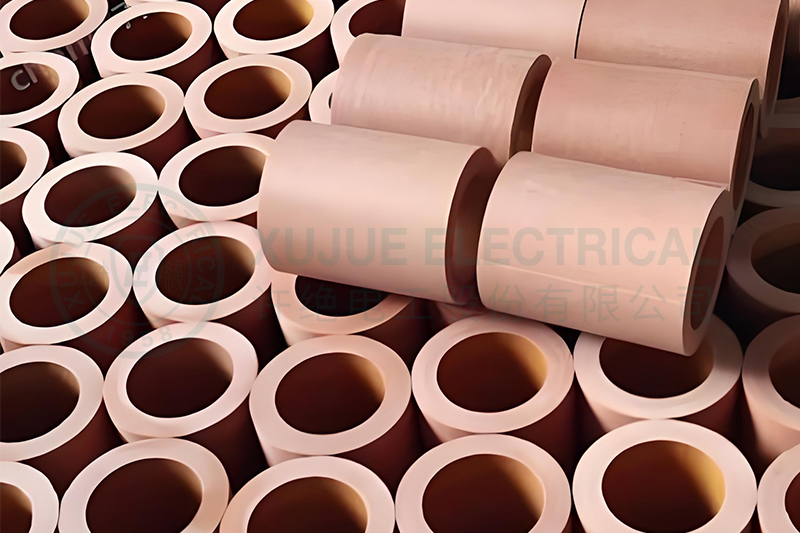
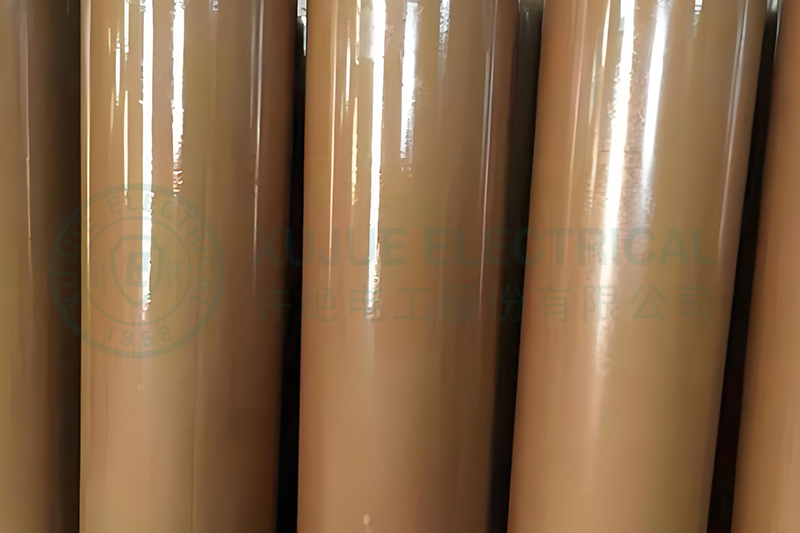
Phenolic paper tube (also called insulation paper tube or bakelite paper tube) is a rigid laminated insulation tube made by impregnating electrical insulation paper with phenolic resin, then winding and hot pressing. Standard grades typically correspond to 3640 / PFCP22 series.
In transformers, phenolic paper tubes serve the following key functions:
Coil former and support: acts as winding skeleton and withstands radial pressure from winding tension
Interlayer insulation spacing: provides insulation barrier between HV and LV windings
Lead wire protection: prevents mechanical damage at conductor exit points
Mechanical spacing structure: forms oil ducts with insulation board for cooling in oil transformers
Application scope: This article focuses on phenolic paper tubes used in distribution transformers up to 35kV.
Many engineers confuse mechanical pressure strength and dielectric withstand voltage, but they are completely different parameters.
Dielectric Strength
Represents the material’s resistance to electrical breakdown
Unit: kV/mm (breakdown field strength)
Test method: power-frequency withstand voltage test
Typical value for phenolic tube: ≥8 kV/mm
Mechanical Compressive Strength
Represents resistance to radial or axial compression
Unit: MPa
Typical value for phenolic tube: ≥80 MPa (axial)
Common mistake: “pressure rating” may refer to mechanical strength or dielectric withstand voltage.
Phenolic tube material properties follow GB/T 1303 and GB 7672, while transformer insulation testing follows GB 1094.3 and DL/T 573.
| Transformer Rated Voltage | Induced Withstand Voltage | Applied Withstand Voltage | Recommended Wall Thickness |
|---|---|---|---|
| 0.4 kV | 1.0 kV | 3.0 kV | 1.5–3 mm |
| 3 kV | 6.5 kV | 10 kV | 3–5 mm |
| 6 kV | 12 kV | 20 kV | 5–8 mm |
| 10 kV | 20 kV | 35 kV | 8–12 mm |
| 35 kV | 70 kV | 80 kV | 12–20 mm |
| Property | Unit | Standard Value | Notes |
|---|---|---|---|
| Thermal Class | – | Class E 120°C | Up to Class F 155°C |
| Dielectric Strength | kV/mm | ≥8 | 12~15 after oil impregnation |
| Axial Compression Strength | MPa | ≥80 | – |
| Insulation Resistance | MΩ | ≥100 | – |
| Water Absorption | % | ≤1.0 | Keep dry |
| Comparison | Phenolic Paper Tube | FR4 Tube | Phenolic Cotton Tube |
|---|---|---|---|
| Thermal Class | 120°C | 155°C | 120°C |
| Dielectric Strength | ≥8 | ≥14 | ≥5 |
| Mechanical Strength | Medium | High | Medium |
| Cost | Low | High | Medium |
Confirm transformer type: dry-type or oil-immersed
Check rated voltage and insulation requirement
Calculate wall thickness based on dielectric strength
Verify thermal class meets temperature rise
Match inner diameter to winding process
Control moisture content and storage conditions
| Failure | Cause | Solution |
|---|---|---|
| Electrical breakdown | Moisture or insufficient thickness | Drying and increase thickness |
| Cracking | Excess winding tension | Control winding tension |
| Insulation degradation | Thermal aging | Upgrade thermal class |
| Deformation | Poor storage | Vertical storage |
What is the difference between phenolic and FR4 dielectric strength?
Phenolic tube about 8kV/mm, FR4 above 14kV/mm.
Does thicker wall mean higher voltage withstand?
Material strength stays same, but total withstand voltage increases.
Can phenolic tubes be used in dry-type transformers?
Yes, but F-class or FR4 is recommended.
Typical size range?
Inner diameter φ10mm–φ300mm, wall thickness 1.5mm–30mm, customizable.
If you need our products please write down any questions, we will reply as soon as possible.
There are three ISO certificates for quality certification. The certificates will be shown later. ISO
After receiving the advance payment, the production cycle is 15-25 days. And the transportation cycle should be calcul……
We supply with installation guide and user manual for each transformer. If you do not understand them. We will offer v……
