A fiberglass filament wound tube is a hollow composite cylinder formed by wrapping resin-impregnated glass fibers around a mandrel using computer-controlled winding equipment. After curing, the mandrel is removed, leaving a seamless tube with engineered mechanical and electrical properties. By adjusting fiber orientation, wall thickness, and resin composition, manufacturers can tailor the tube for specific insulation and structural requirements.
These tubes are commonly used as structural insulation supports, transformer coil formers, busbar spacers, and high-voltage standoff insulators. Their combination of high dielectric strength, dimensional stability, corrosion resistance, and lightweight design makes them indispensable in power engineering and electrical equipment manufacturing.
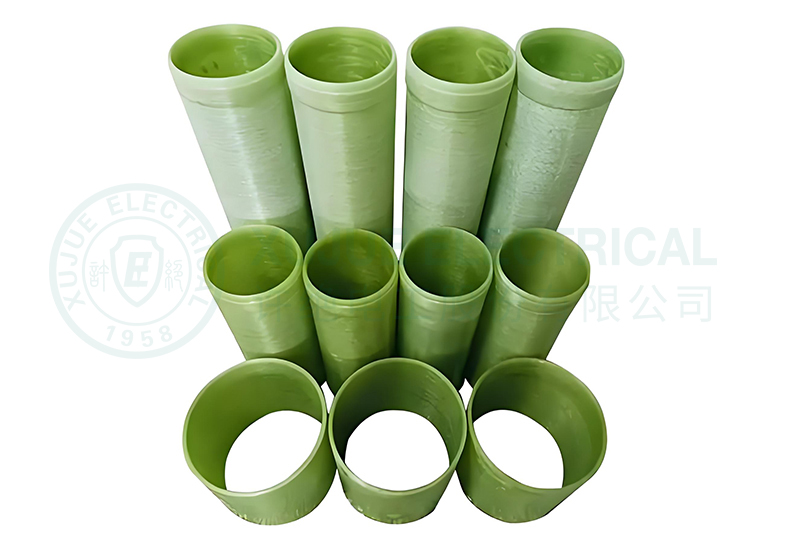
Fiberglass filament wound insulation tubes offer excellent electrical and mechanical properties suitable for high voltage applications. Typical dielectric strength ranges from 20 kV/mm to 30 kV/mm. Loss tangent values remain below 10⁻³, ensuring minimal dielectric heating. Maximum operating temperatures can reach 180°C for Class H insulation systems. Fiber volume fraction typically falls between 60% and 70%, providing outstanding structural strength and reliability.
The manufacturing process begins with a precision machined steel or aluminum mandrel mounted on a filament winding machine. Continuous glass fiber rovings pass through a resin bath or are supplied as pre-impregnated material. A programmable carriage then winds the fibers onto the mandrel following predefined angles and patterns. After winding, the composite structure undergoes controlled thermal curing, ensuring complete polymerization and optimal electrical properties.
Fiber orientation plays a critical role in determining tube performance. Hoop windings near 90 degrees provide maximum circumferential strength, which is beneficial for pressure and radial loads. Helical windings between 45 and 55 degrees balance axial and radial strength, making them suitable for general insulation applications. Low-angle windings between 15 and 30 degrees enhance axial stiffness for cantilevered supports and structural insulators.
Epoxy resin systems dominate the high voltage insulation market because of their excellent adhesion, low void content, and superior dielectric properties. Cycloaliphatic epoxy offers improved UV resistance and tracking resistance for outdoor installations. Silicone-modified epoxy enhances flexibility under thermal cycling, while polyimide or cyanate ester systems are used for extreme temperature environments.
After winding, tubes are cured at temperatures typically ranging from 120°C to 180°C. Post-curing further increases glass transition temperature and ensures long-term dielectric stability.
Representative properties for epoxy glass filament wound tubes include high dielectric strength, excellent volume resistivity above 10¹² Ω·cm, low permittivity between 4.2 and 4.8, and low dielectric loss. Mechanical properties include hoop tensile strength up to 500 MPa and compressive strength up to 250 MPa. Water absorption remains below 0.3%, ensuring reliable performance in humid environments.
Fiberglass filament wound insulation tubes are commonly manufactured according to international standards. IEC 60893 defines electrical grade laminated materials equivalent to G10 and G11 classifications. IEC 60076-11 applies to dry-type transformer insulation systems, while IEC 60270 governs partial discharge testing. ASTM standards such as ASTM D2290 and ASTM D695 define mechanical performance requirements. UL94 V-0 flame classification is often required for North American markets.
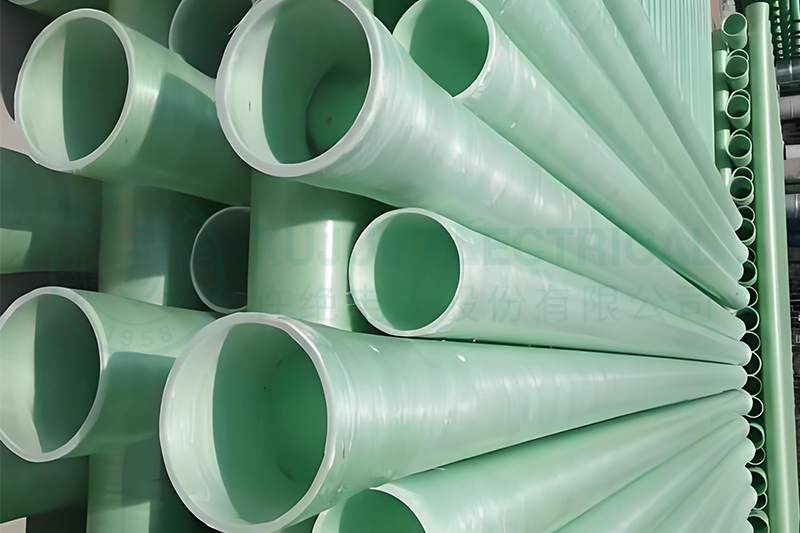
Filament wound tubes are widely used as coil formers in dry-type transformers operating from 6 kV to 72.5 kV. They provide mechanical support for windings while maintaining dielectric integrity under thermal cycling and impulse voltage stress.
In GIS equipment, fiberglass wound tubes function as spacers and structural insulation barriers. Their low moisture absorption and high dielectric strength ensure reliable performance in SF₆ gas environments.
Current transformers and voltage transformers utilize filament wound cylinders as primary insulation housings. Custom winding patterns allow increased creepage distance and improved contamination resistance.
Fiberglass filament wound tubes serve as structural backbones for bushings used in transformers and circuit breakers. Their lightweight and non-brittle nature provide improved seismic resistance compared to porcelain.
Additional applications include capacitor banks, reactor insulation supports, cable terminations, electrostatic precipitators, and accelerator power supplies. These applications benefit from the composite material’s non-magnetic properties and high insulation reliability.
When selecting a fiberglass filament wound tube, engineers must define operating voltage, insulation class, mechanical load conditions, thermal class, and environmental requirements. Mechanical loading determines fiber orientation, while temperature class dictates resin selection. Dimensional tolerances and surface finish must also be specified to ensure proper assembly and long-term performance.
High quality insulation tubes undergo dimensional inspection, dielectric testing, and partial discharge measurement. Many manufacturers perform 100% PD testing for critical applications. Thermal aging tests validate long-term reliability, confirming that insulation strength remains stable throughout service life.
These tubes offer high dielectric strength, excellent mechanical performance, corrosion resistance, low weight, and long service life. They are suitable for indoor and outdoor installations, including polluted environments. Compared with traditional ceramic insulation, composite tubes provide better impact resistance and reduced maintenance.
Fiberglass filament wound tubes represent a highly engineered insulation solution for modern power systems. Their customizable fiber architecture allows designers to optimize performance for electrical, mechanical, and thermal requirements. As grid voltages increase and equipment compactness becomes more important, demand for advanced composite insulation continues to grow. Selecting properly specified filament wound tubes ensures reliable protection for transformers, switchgear, and high voltage infrastructure over decades of operation.
If you need our products please write down any questions, we will reply as soon as possible.
There are three ISO certificates for quality certification. The certificates will be shown later. ISO
After receiving the advance payment, the production cycle is 15-25 days. And the transportation cycle should be calcul……
We supply with installation guide and user manual for each transformer. If you do not understand them. We will offer v……
